It Begins: the AI-Stablecoin Payment Rails
Taiwan, a US protectorate circa 2018 (since the pre-Xi American alliance with China ended), officially announced integrating its AI industry with the American stablecoin payment rails.
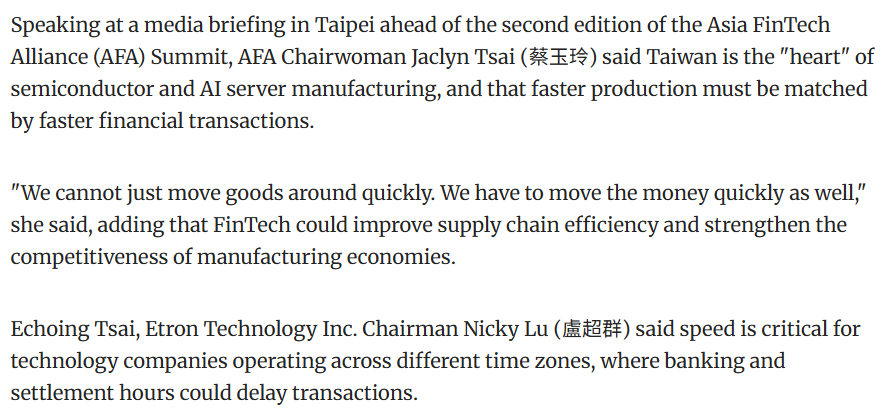
 Focus Taiwan - CNA English News
Direct AI Capital Through Stablecoin Conduits
Why would Taiwan care about using stablecoins for payment and reconciliation of trade for AI products and services?
Simple: it forces other countries (pretty much the rest of the world) that use its Taiwan-produced AI GPU's and software to deploy stablecoin payment rails.
Because Taiwan will eventually only accept stablecoins for AI exports, it means that importers of AI goods and services will have to settle trade in stablecoins.
Capital Flows into Stablecoins forces PBoC to Lift Peg
With capital pivoting from US dollars, which the PBoC can easily purchase, to stablecoins, the PBoC must BUY stablecoins and SELL RMB to avoid the RMB appreciating against the USD dollar.
Fully anticipating the US' decentralized payment rail attack on the RMB-USD peg, the PBoC already launched and continues to scale its digital Yuan:
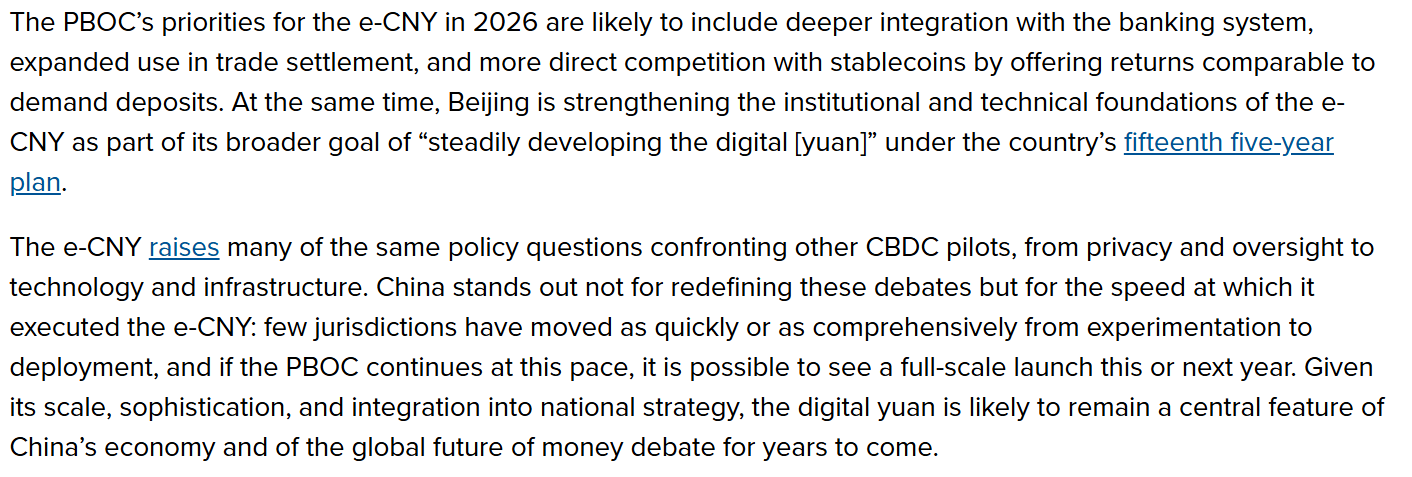
China Hates Anonymity & Lack of Control
The biggest problem with American stablecoin infrastructure is its anonymity: China absolutely depends on finely-controlled capital controls, with identity its first priority:
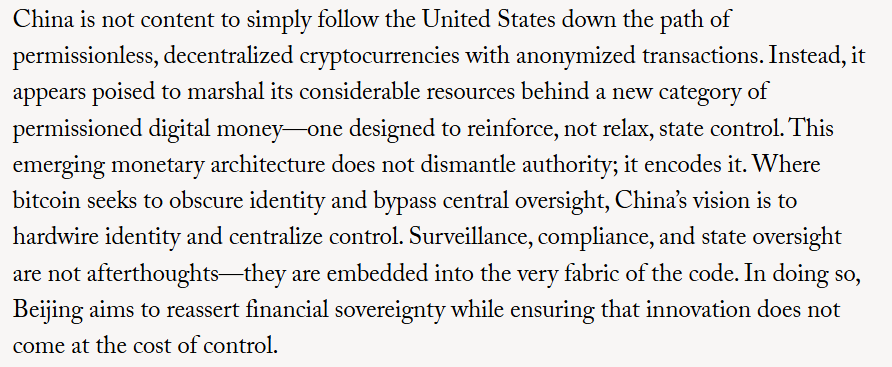
The US, seeing this vulnerability, enabled stablecoin rails precisely because they do appeal to Chinese exporters holding surpluses seeking to anonymously, cheaply, and quickly stash their surplus out of the hands of the Chinese government and financial system.
That crypto intrinsically by-passes the PBoC's "financial repression", essential for propping-up otherwise uncompetitive "strategic exports", be it memory chips, electric cars, or steel, proves the the icing on the cake.
From the PBoC, itself:
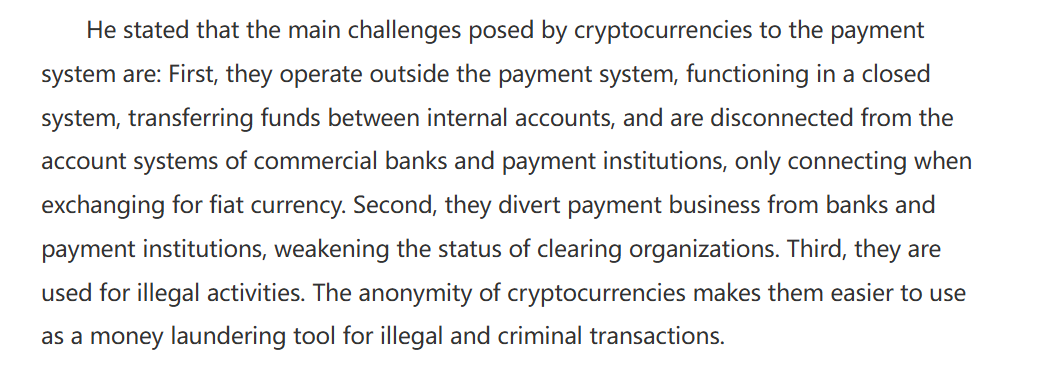
Stablecoins & GENIUS Act: Friction-less Capital Inflows to the US & Undermining PBoC & Chinese Competitiveness
The US "exports" stablecoins to provide anonymous, fast, and secure capital rails for foreign capital to escape policy and repression at home, all the while "taxing" and "undermining" the control and financial repression mechanisms essential for the PBoC's ability to engineer sustained Chinese surpluses and positive return on capital invested for "strategic industries".