post-AI SaaS & Erdos Problems
There's actually a deep connection between viable post-AI SaaS companies and the astonishing (albeit not surprising) solution to the Erdos "Unit Distance" problem.
LLM-based AI - Amazing at "Making Logical Connections"
The gist of the Erdos "Unit Distance" solution came from approaching the problem in a completely novel path - note that specific word, path.
Thus, with its massively higher-dimensional representation space (albeit not actually using all those dimensions and surely pruning and regularizing here-and-there), the Erdos "Unit Distance" LLM solver managed to pull insights and structures from Algebraic Number theory, a COMPLETELY novel approach:
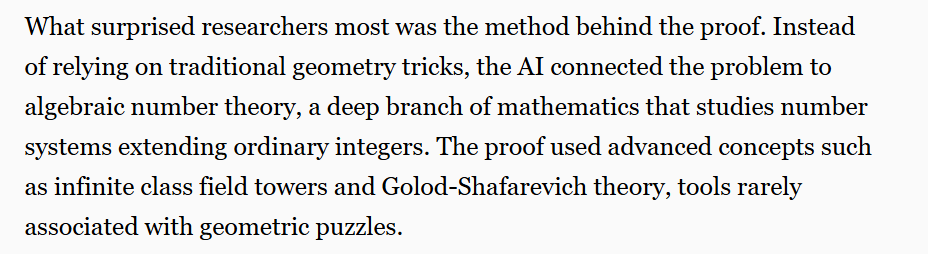
Note how the LLM managed to bridge a connection between an entirely different sub-discipline of mathematic, Algebraic Number theory, with Discrete Geometry.
This SUPER POWER of AI, in the logical domain, however, can not be naively mapped to the truth domain, i.e. "physical reality". Those trying to apply LLM's in physics, especially in chemistry, have struggled to apply LLM's with any success (see the efforts to apply LLM's with limited success to retrosynthetic planning, for example, where even tuned models struggle with accuracy above 50%, and still suffer from catastrophic hallucinations.)
Logic Isn't Reality: Why OpenAI and Anthropic Still Use a CRM
Anthropic, OpenAI, xAI, et cetera all have SaaS enterprise contracts. Would it not make sense to "spin these up" and maintain them using an agent?
The reason these AI companies still use SaaS software is the same reason people don't mix their own concrete, despite having the formula online: physics.
Implied in a standard CRM tool is, in fact, decades of physical interaction across businesses, legal norms, cultures, and economic cycles. To replicate the business logic means to replicate the physics of commercial behavior through a CRM - it's not logical - it's physical. "Business logic" isn't, actually, "logic", at all - it's physical behavior modeled to a computer interface: implied within a "business logic" are innumerable constraints as one adds dimensions to his model - thus, the "sparse business logic" may prove to be a very unstable and hyper path-dependent projection from higher dimensional vector space.
Could an AI impose logic that simulates a "physical bound" - sure, it can, but how would you guarantee its consistency? Furthermore, is it worth the risk to do so, if there exists even a tiny chance that the underlying business logic, or "physics", changes behavior without prior notice and undermines your efforts (e.g. the CRM agent "hallucinates" and spams your clients with provocative emails and robocalls.)
post-AI SaaS as a "Physical Interface" Insurance
If one sees post-AI SaaS as a "physical interface" to augment a logical AI agent, rather than a "logical machine generating code", then it stands to reason why there are post-SaaS AI winners: a consistent and predictable interaction plane with the physical world, be it human or machine.
Una comparación útil de camiseta visitante de fútbol comienza por la temporada y el contexto de uso del diseño. También ayuda revisar que la ficha identifique claramente la versión elegida antes de completar el pedido.